
RIA Website Strategy and Design
RIA Creative helps advisory firms translate their positioning, expertise and client experience into a digital presence that feels distinctive, credible, and true to the firm they have become.
Explore Our PerspectiveYour website should make the essence of your firm recognizable
RIA Creative provides RIA website strategy and design for registered investment advisors and wealth management firms that need their digital presence to reflect who they have become, communicate what makes them meaningful, and support where the business intends to go next.
Every advisory firm contains a distinctive combination of people, perspective, expertise, values, and experience. Together, those qualities form the essence of the firm and shape which clients will feel most naturally aligned with it.
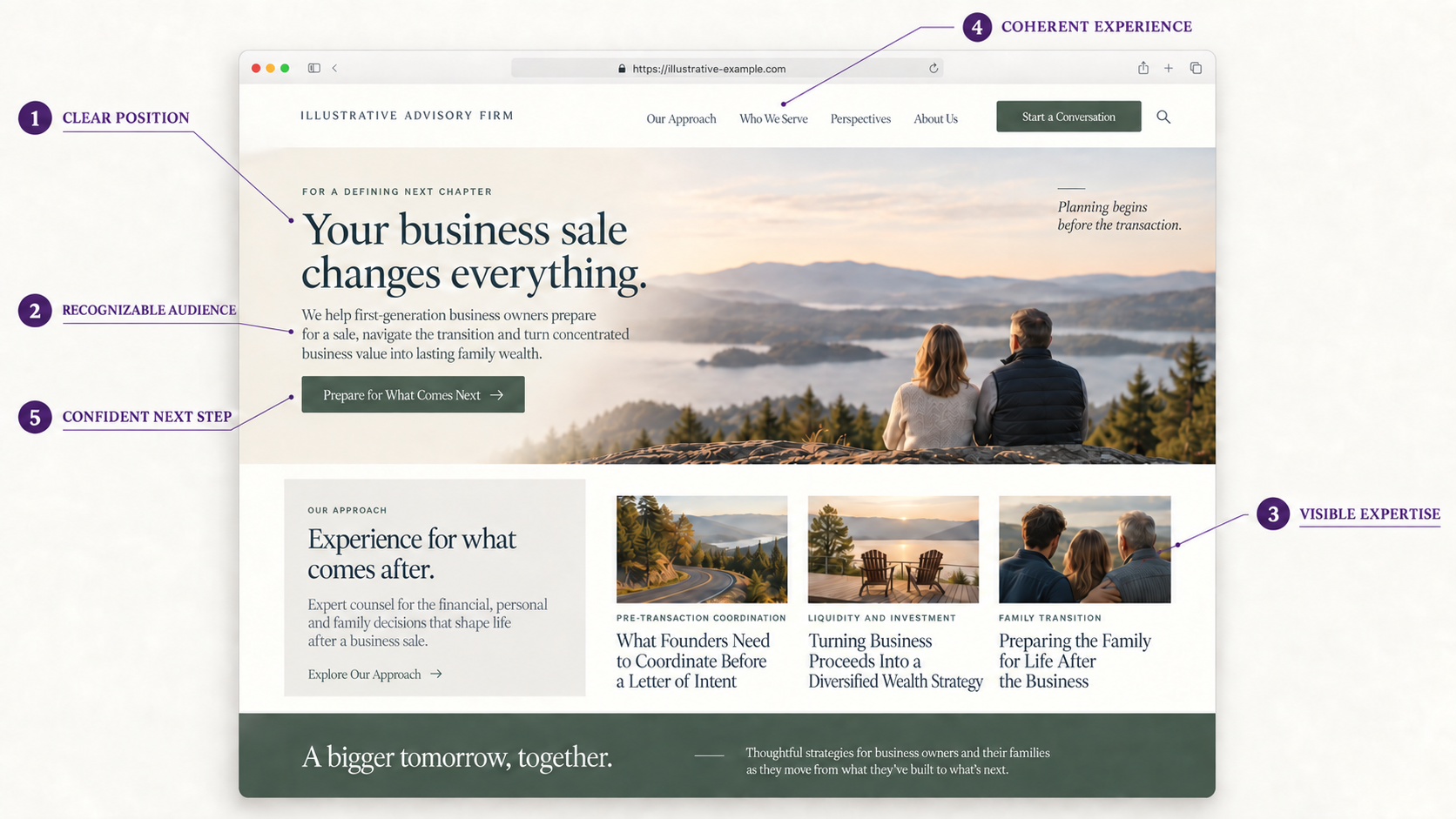
An effective advisory firm website brings that essence into focus. It translates the firm's positioning, expertise, content, design, search visibility, and client experience into one coherent system, with enough clarity and substance for people, search engines, and artificial intelligence to understand the firm accurately.
RIA Website Strategy Now Includes Search and AI Visibility
Prospective clients increasingly use traditional search and artificial intelligence to answer questions, compare approaches, investigate firms, and decide what type of expertise they need.
The website must persuade and educate the person who reads it while giving search engines and AI systems enough specificity and context to understand the organization accurately. That requires clear language about the firm, its audiences, capabilities, professionals, locations, expertise, and perspective, supported by substantive content, descriptive headings, useful internal links, and sound technical foundations.
Strong SEO and Answer Engine Optimization begin with the same strategic discipline that improves the human experience. An AI system cannot manufacture a distinction that does not appear in the available source material.
Search visibility begins with being clear enough to understand and substantive enough to matter.
Technical optimization supports that foundation. It does not replace it.
The journey has shifted
- Referral or Search
- WebsiteThe destination
- Learn
- Evaluate
- Contact
- Question
- Search or AI
- Learn
- Evaluate
- Website
- Validate
- Contact
What Is RIA Website Design
RIA website design is the process of translating an advisory firm's positioning, expertise, services, people, and client experience into a clear and credible digital presence.
It includes business and brand strategy, messaging, content architecture, visual design, search visibility, compliance considerations, user experience, and pathways that help appropriate prospective clients take the next step.
The visual appearance of the website forms an important part of that work, although appearance alone cannot reveal what makes the firm relevant.
The strongest financial advisor websites allow strategy, substance, and design to reinforce one another.
Strategy
The strategy determines what the firm needs to communicate.
Substance
The content gives its expertise and perspective meaningful expression.
Design
The design creates an experience in which the firm's character becomes visible and its ideal clients can recognize a sense of alignment.
Why Financial Advisor Websites Require a Different Approach
This need for recognition carries particular importance in wealth management because prospective clients are choosing people, judgment, values, and a relationship that may shape consequential decisions for many years.
The service depends on trust
Prospective clients cannot fully evaluate financial advice before receiving it. The website becomes one of the first environments in which they assess the people, judgment, discipline, and values behind the advice.
The offering can be difficult to explain
Wealth management often brings several financial disciplines into a connected relationship. The website must make a sophisticated offering understandable while preserving the qualities that make the firm's approach its own.
The industry often sounds interchangeable
Personalized advice and comprehensive planning create little differentiation when nearly every competitor makes the same claims. A strong RIA website identifies the beliefs, knowledge, and ways of working that give those phrases meaning.
The right outcome is alignment
A clearly expressed firm resonates more deeply with people whose needs and values align with its expertise, philosophy, and experience. That same clarity helps others determine that a different firm would suit them better.
The journey rarely follows a straight line
A prospective client may hear about the firm through a referral, a Google search, LinkedIn, or an AI system, and return to the website several times. The website must preserve a coherent expression of the firm across that journey.
Communication must support compliance
Advisory firms must communicate persuasively while maintaining accuracy, balance, substantiation, and required disclosures. Compliance should inform the content early, without stripping the website of specificity and character.
Interchangeable or recognizable
- “Personalized advice”
- “Comprehensive planning”
- “Customized strategies”
- “Long term relationships”
Accurate, and claimed by nearly every credible competitor.
“We work with families in the two years after selling a business, when one decision about the proceeds shapes the next thirty years.”
Illustrative example
Specific about who the firm serves, the moment it serves them, and what is at stake.
An RIA Website Is More Than a Design Project
Many website projects begin with production questions: how many pages the site should contain, which platform should support it, what the homepage should look like, and how quickly it can launch. Those decisions matter, but they come later.
An advisory firm should first determine what the website needs to reveal. A website cannot clearly express a strategy the firm has never defined, and it cannot communicate a distinctive identity that no one has taken the time to understand.
Effective financial advisor website design begins by understanding the firm itself.
- Who is the firm best equipped to serve?
- What decisions does it help those clients navigate?
- What expertise has the organization developed?
- What does it understand that others may overlook?
- What shapes its judgment?
- How do clients experience the relationship?
- Why should a particular prospective client recognize the firm as especially relevant?
Revealing the Essence of the Firm
Together, those qualities form the essence of the firm.
Every advisory firm contains something more distinctive than its list of services. That distinction may emerge from the people it serves particularly well, the experiences that shaped its perspective, the standards that guide its work, or the way clients feel when they interact with the firm.
RIA Creative begins by finding that essence and making it visible. We then translate that understanding into positioning, messaging, content, design, and a digital experience that feels specific to the firm.
Clarity Is What Turns Marketing Into Momentum
When positioning, communication, and client experience reinforce one another, marketing becomes more coherent, and the right clients can more readily recognize why the firm is relevant to them.
Explore Our PerspectiveThe Five Responsibilities of a Modern RIA Website
A modern RIA website carries five connected responsibilities, each beginning with an understanding of the firm's essence.
- Create Clarity
- Establish Authority
- Organize Knowledge
- Create an Experience
- Support Aligned Growth
Create clarity
The website should help people understand who the firm is, whom it serves, what it knows, how it works, and why those qualities may matter to them.
Establish authority
The website should demonstrate the expertise that gives the firm's positioning credibility: advisor experience, substantive perspectives, specialized knowledge, original research, and evidence supporting important claims.
Organize knowledge
The website should create understandable relationships among audiences, services, professionals, expertise, locations, perspectives, and educational content, giving search engines and AI systems clearer context for interpreting the firm.
Create an experience
The website should allow the firm's character to be felt as well as understood through typography, photography, language, navigation, pacing, accessibility, and visual hierarchy.
Support aligned growth
The website should help the right relationships move forward. For many RIAs, growth requires stronger alignment between the organization and the people who ultimately choose it, rather than the greatest possible number of leads.
Effective RIA Website Design Begins Before Design
The quality of the finished website depends on how deeply the firm has been understood before visual design begins.
Positioning and audience
Positioning identifies the relationship between the essence of the firm and the clients most likely to value it.
Message architecture
Message architecture identifies the central idea the market should understand, the supporting messages that make that idea credible, and the evidence required to substantiate important claims.
Content architecture
Content architecture gives the firm's knowledge and perspective a place to live. A concise homepage can remain elegant when deeper pages explain audiences, services, expertise, advisors, and perspectives with appropriate substance.
Client journey
The website should reflect how appropriate prospective clients discover, evaluate, and build confidence in the firm.
Visual expression
Color, typography, layout, imagery, interaction, and space should express the organization's character rather than simply follow current aesthetic conventions.
What an RIA Website Should Include
An RIA website should include enough information to explain the firm clearly, establish credibility, demonstrate expertise, and help appropriate prospective clients determine whether a conversation makes sense.
- A clear explanation of the firm and its relevance
- Defined audiences, circumstances, or client needs
- Meaningful descriptions of services and capabilities
- Advisor biographies that communicate experience and perspective
- An understandable explanation of the firm's approach
- Evidence supporting claims of expertise and specialization
- Educational content and original perspectives
- Appropriate trust signals, disclosures, and regulatory information
- Clear pathways to contact the firm
- Accessible, responsive, and search friendly foundations
- Internal links connecting related subjects
- A structure capable of evolving with the business

A Financial Advisor Website Still Needs to Be Beautiful
People experience the website visually and emotionally. They notice whether it feels considered, whether its language respects their intelligence, whether the navigation feels intuitive, and whether the overall experience reflects the level of sophistication they expect from the firm.
The challenge is to create a sophisticated human experience supported by a deep and understandable information architecture. The visible surface can remain elegant because the substance beneath it has been thoughtfully organized.
RIA Creative Approach to
Website Strategy and Design
Understand the firm
We examine the organization's direction, audiences, expertise, culture, client experience, competitive environment, and growth priorities.
Define the digital strategy
We determine what the website needs to communicate, whom it needs to serve, and how it should support discovery and evaluation.
Build the message and content architecture
We establish the central narrative, supporting messages, page hierarchy, content requirements, subject relationships, and pathways through the site.
Create the experience
We translate the strategy into language, design, navigation, imagery, interaction, and an experience that feels appropriate for the firm.
Prepare the site for discovery
We incorporate search fundamentals, clear content structure, internal linking, accessible information, and contextual signals that help digital systems understand the firm.
Build a foundation that can evolve
The structure should accommodate new insights, evolving expertise, changing audiences, recruiting needs, and future growth.
A Clearer Path From Visibility to Growth
When positioning, communication, visibility, and client experience reinforce the same understanding of the firm, the right clients can more easily recognize its relevance.
Explore Our PerspectiveWhen an RIA Should Redesign Its Website
An RIA should consider redesigning its website when the existing digital presence no longer represents the firm accurately, supports its strategy effectively, or creates an experience appropriate for its intended audience. Common signs include:
- The firm has evolved while the website still reflects an earlier version of the business.
- The messaging could describe nearly any advisory firm.
- Important expertise remains difficult to find or understand.
- The website does not speak clearly to the clients the firm most wants to serve.
- The design no longer reflects the organization's sophistication.
- Advisors hesitate to send prospective clients to the site.
- Visitors struggle to understand services, audiences, or next steps.
- The content structure cannot support new perspectives or growth initiatives.
- The website produces inquiries that rarely fit the firm.
A redesign should address the causes of these problems rather than giving the existing site a new visual surface.
How an RIA Should Measure Website Success
The website succeeds when it creates a clearer relationship between the firm and the people it is best equipped to serve.
The central question is whether the website helps the right people understand the firm more clearly and move toward it with greater confidence.
- Qualified and aligned inquiries
- Improved conversion quality
- Engagement with high value pages
- Visibility for relevant searches
- Greater confidence among referral sources
- Prospects arriving at conversations better informed
- Advisor confidence when sharing the website
- Content helping prospective clients understand the firm's expertise
- Recruiting and business development support
- Accurate representation of the firm's current identity and direction
Frequently Asked Questions About RIA Website Design
What is RIA website design?
RIA website design translates an advisory firm’s strategy, positioning, expertise, services, people, and client experience into a clear digital presence. The process includes messaging, content architecture, visual design, user experience, search visibility, compliance considerations, and conversion pathways.
What makes a good financial advisor website?
A good financial advisor website clearly explains whom the firm serves, what it helps clients accomplish, what makes its expertise relevant, and what someone can expect from the relationship. It combines substantive information with a credible, intuitive, and visually coherent experience.
Can AI systems understand an advisory firm from its website?
AI systems can use publicly accessible website content as part of their understanding of an advisory firm. Clear descriptions of audiences, services, expertise, professionals, locations, and perspectives make accurate interpretation more likely. The website cannot control every AI generated answer, but it can provide clearer source material.
How does SEO affect financial advisor website design?
SEO influences page structure, content, headings, internal links, technical performance, accessibility, and the way information is organized. Strong SEO should support the visitor’s understanding of the firm rather than force awkward keywords or unnecessary content into the experience.
How much content should an RIA website include?
An RIA website should include enough content to answer important questions, communicate meaningful differences, and substantiate the firm’s expertise. The appropriate amount depends on the complexity of the organization, its audiences, services, and growth strategy. Clear architecture matters more than an arbitrary word count.
How often should an RIA redesign its website?
An RIA should redesign its website when the site no longer represents the business accurately or supports its goals effectively. Changes in positioning, leadership, services, audiences, ownership, growth strategy, or technology may create the need.
Should an RIA website focus on a specific type of client?
A firm that has developed meaningful relevance for a particular audience should make that relevance clear. Specificity helps prospective clients recognize fit and gives search engines and AI systems better information about the firm.
Does an RIA website need thought leadership?
Thought leadership can help an advisory firm demonstrate expertise, articulate its perspective, educate prospective clients, and create greater visibility around relevant subjects. Publishing volume alone does not establish authority. The content must contain useful knowledge and reflect genuine expertise.
How should compliance fit into the website process?
Compliance should participate early enough to identify regulatory concerns, substantiate claims, and support accurate communication. Early involvement generally produces a stronger result than waiting until the final stage to repair problematic language.
What should an RIA look for in a website strategy partner?
An RIA should look for a partner capable of understanding the business behind the website, including positioning, client experience, industry dynamics, content, search visibility, compliance considerations, and growth goals. Technical and design capabilities should serve that strategic foundation.
Build a Website That Makes the Firm Recognizable
The strongest advisory websites reveal the character of the organization, clarify whom it is built to serve, make its expertise visible, and create an experience that allows aligned prospective clients to recognize why the relationship may be right for them.
The website should make that essence unmistakably clear.
Be More Recognizable to the Clients You Serve
RIA Creative helps advisory firms clarify their positioning and connect their communication, digital presence, and client experience around a more intentional path forward.
Explore Ways to Work Together